

Why QR stencils need bridges
For a dark code sprayed onto a light surface, the dark QR modules become holes in the sheet. Any light region surrounded entirely by holes becomes an unsupported island. Without a bridge, that piece falls out and the QR pattern changes.
QRacade detects those disconnected light regions, searches for a short route to the supported material and subtracts a narrow bridge from the affected cut modules. It does not remove entire modules. The status reports how many islands were connected and whether any bridge crosses a structural QR area.
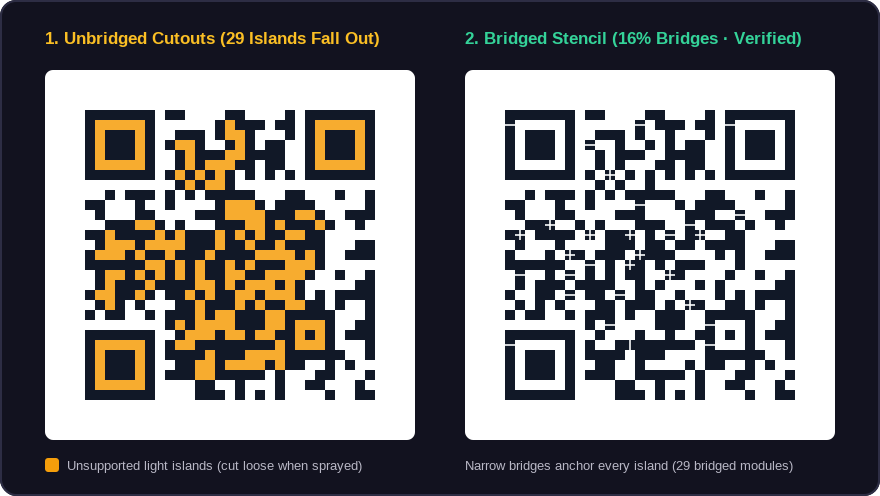
https://qracade.com: amber blocks on the left would drop out of a laser-cut sheet; narrow 16% bridges on the right anchor every island while keeping the code decodable.How to make the stencil
- Use the shortest stable URL you control and generate the design.
- Confirm that the digital result says Verified; otherwise shorten the content or try a narrower bridge.
- Download the SVG and import it into the cutting software at the required physical size.
- Check the cutter and material's minimum feature size. A digitally visible bridge may still be too weak in paper, card or plastic.
- Cut one proof, spray a flat matte test surface and scan it with more than one phone.
Choose a physical bridge, not just a percentage
The selector defines bridge width relative to one QR module. Its physical width therefore depends on the final stencil size. A 16% bridge in a large outdoor code is very different from the same percentage on a small card.
| Stencil code width (v4, 33×33) | 1 module | 12% bridge | 16% bridge | 24% bridge |
|---|---|---|---|---|
| 100 mm (small card/sign) | ~3.0 mm | ~0.36 mm (fragile) | ~0.48 mm | ~0.73 mm |
| 300 mm (crate / wall stencil) | ~9.1 mm | ~1.09 mm | ~1.45 mm | ~2.18 mm |
| 1,000 mm (pavement / mural) | ~30.3 mm | ~3.64 mm | ~4.85 mm | ~7.27 mm |
Narrow bridges preserve more of the original QR modules but can tear, burn away or be impossible to cut. Wider bridges are stronger but alter more of the symbol. There is no universally safe ratio; material, cutter, paint and final module size all matter.
What the SVG contains
The SVG contains plain vector rectangles for every remaining cut area, a light background and no embedded bitmap or mask. This makes the geometry accessible to common vector-cutting workflows. Your machine software may still need its own line, fill or layer interpretation, so inspect the imported paths before cutting.
Digital verification is only the first test
Before enabling downloads, QRacade decodes the rendered bridged image and compares the content with your input. This validates the digital design, not the manufacturing process. Paint spread, overspray, surface texture, curved objects, weak bridges and low contrast can all change the result.
For related production guidance, see metal-tag QR codes, print size and materials, and colour contrast.
Frequently asked questions
Why does a QR stencil need bridges?
Unsupported light islands would fall out when surrounded by cuts. Narrow material bridges keep them connected while retaining most of each affected module.
Is the SVG suitable for a cutting machine?
It contains plain vector rectangles without bitmap or mask dependencies. Check your cutter's import rules and minimum physical features.
Does digital verification prove the sprayed code will scan?
No. It verifies the digital design only. Make and scan a real proof under the intended conditions.
What bridge width should I use?
Choose based on material, cutter, physical module size and strength. No single ratio is safe for every production setup.
Can I use a long URL?
Use the shortest practical stable URL. Dense codes are harder to cut and scan, especially at small sizes.